What Is the BCG Vaccine?
BCG stands for Bacillus Calmette-Guérin, named after the two French scientists, Albert Calmette and Camille Guérin, who developed the vaccine in the early 20th century.
The vaccine was introduced in 1921 after years of research and became one of the most widely administered vaccines in history.
Its primary purpose is to help protect against severe forms of tuberculosis, a bacterial disease caused by Mycobacterium tuberculosis. TB most commonly affects the lungs but can also spread to other organs, including the brain, bones, kidneys, and spine.
Before antibiotics became widely available, tuberculosis was one of the deadliest infectious diseases in the world.
Entire families were devastated by it, and sanatoriums filled with patients suffering from chronic coughing, weight loss, fever, and fatigue.
The introduction of the BCG vaccine represented a major milestone in global public health.
Why Does the Vaccine Leave a Scar?
Unlike many modern vaccines, the BCG vaccine is typically administered just beneath the skin rather than deep into the muscle.
After the injection, the body begins an immune response.
This process usually follows several stages:
A small bump appears at the injection site.
The bump may develop into a tiny blister.
A small ulcer sometimes forms.
The area gradually heals over several weeks.
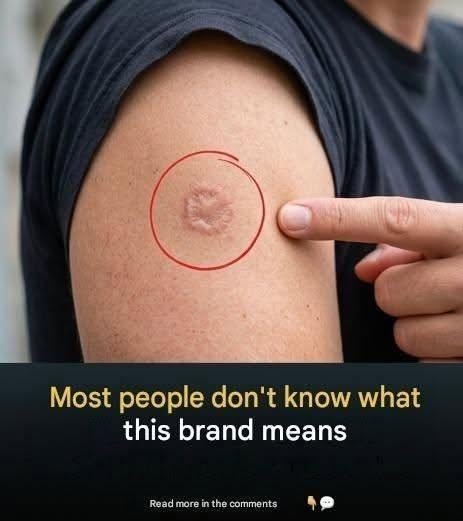
A permanent circular scar remains.
This sequence is considered a normal part of the healing process.
Not everyone develops exactly the same scar. Some people have a tiny, barely visible mark, while others have a larger, more noticeable indentation.
The size depends on factors such as individual healing, immune response, and the injection technique used.
Why Was It Usually Given on the Upper Arm?
The upper arm became the preferred injection site for several practical reasons.
It provides easy access for healthcare workers, heals well, and leaves a scar in an area that generally causes little cosmetic concern.
This location also allows medical professionals to verify that the vaccine was successfully administered, since the scar often serves as visible evidence of prior vaccination.
Is the Scar Dangerous?
For healthy individuals, the scar itself is completely harmless.
It does not indicate an active infection or illness.
It is simply healed skin where the immune system responded to the vaccine.
The scar generally requires no treatment and causes no long-term health problems.
Only in very rare situations—typically involving people with severely weakened immune systems—can complications occur after BCG vaccination.
For the vast majority of people, however, the scar remains nothing more than a lifelong reminder of childhood immunization.
Why Don’t Younger People Have the Scar?
One reason many younger adults have never seen this scar is that vaccination policies have changed in many countries.
As tuberculosis became less common in regions with strong healthcare systems, routine universal BCG vaccination was gradually discontinued.
Instead of vaccinating every newborn, many countries now recommend the vaccine only for individuals considered at higher risk of exposure.
As a result, people born in recent decades may never have received the vaccine at all.
Tuberculosis: A Disease That Changed History
To understand why so many people received the BCG vaccine, it helps to appreciate just how devastating tuberculosis once was.
For centuries, TB claimed millions of lives worldwide.
Known historically as “consumption,” the disease slowly weakened patients over months or even years.