Have you ever looked closely at your fingernails and noticed unusual lines, ridges, grooves, or discoloration? If so, you’re not alone. Nail changes are surprisingly common and often become more noticeable as we age.
Social media posts and sensational headlines frequently claim that certain nail markings are a sure sign of a serious illness, including cancer. While it’s true that nails can sometimes provide clues about underlying health conditions, the reality is much more complex. Most nail lines are harmless and may be related to aging, minor injuries, nutritional factors, or temporary health changes.
That said, there are situations where changes in the appearance of your nails deserve medical attention.
In this article, we’ll explore the different types of nail lines, what they may indicate, when they are harmless, and when it’s wise to seek professional advice.
Your Nails Can Reveal More Than You Think
Nails are made primarily of a protein called keratin. They grow from a structure beneath the skin known as the nail matrix.
Because nails grow slowly over time, they can sometimes serve as a record of events that have affected the body. Illnesses, nutritional deficiencies, injuries, infections, and certain medical conditions can all influence nail growth and appearance.
Doctors occasionally examine the nails as part of a physical assessment because nail changes can offer useful clues about overall health.
However, it’s important to remember that nail changes alone rarely provide enough information to diagnose a specific disease.
Understanding Different Types of Nail Lines
Not all nail lines are the same. Their direction, color, depth, and location can provide important clues.
Let’s take a closer look at the most common types.
Vertical Ridges
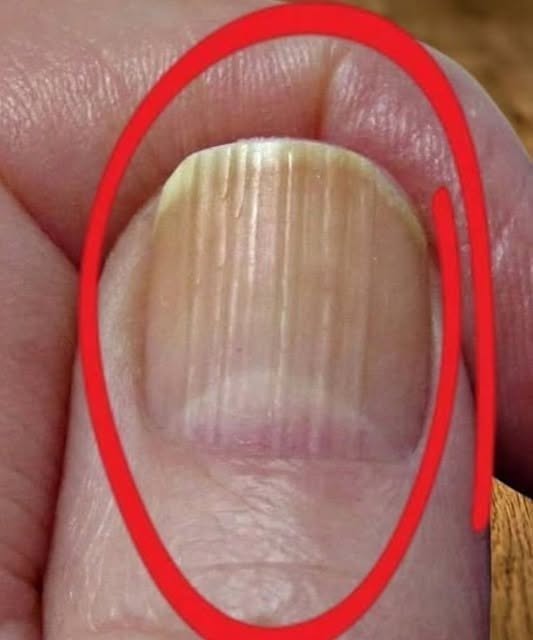
Vertical ridges run from the base of the nail to the tip.
These are among the most common nail changes and are usually harmless.
Many people notice vertical ridges becoming more pronounced with age. Just as skin develops wrinkles over time, nails can develop ridges as part of the natural aging process.
Common causes include:
- Normal aging
- Mild dehydration
- Minor nutritional changes
- Everyday wear and tear
In most cases, vertical ridges are not a cause for concern.
Horizontal Ridges
Horizontal ridges, often called Beau’s lines, run across the nail from side to side.
Unlike vertical ridges, these lines sometimes indicate that nail growth was temporarily interrupted.
Possible causes include:
- Severe illness
Health
- High fever
- Significant stress
- Surgery
- Major infections
- Certain medications
When the body experiences substantial physical stress, nail growth may slow or temporarily stop. As growth resumes, a horizontal groove can appear.
Because nails grow slowly, these lines may not become visible until weeks after the triggering event.
White Lines Across the Nails
Some people notice white horizontal lines or streaks on their nails.
These may result from:
- Minor trauma
Skin & Nail Care
- Nail injuries
- Nutritional issues
- Certain medical conditions
In many cases, white lines are harmless and eventually grow out with the nail.
Persistent or widespread changes should be evaluated by a healthcare professional.
Dark Lines Under the Nail
One nail change that deserves attention is the appearance of a dark brown or black line running vertically beneath the nail.
This condition is sometimes called longitudinal melanonychia.
Possible causes include:
- Benign pigmentation
- Nail injury
- Certain medications
Aging & Geriatrics
- Fungal infections
- Rarely, melanoma
Melanoma is a serious form of skin cancer that can occasionally develop beneath a nail.
While most dark nail streaks are not cancerous, a new, widening, irregular, or changing dark line should be assessed by a medical professional, especially if it appears on only one nail.
Can Nail Lines Mean Cancer?
This is where many viral posts become misleading.
The answer is: sometimes, but rarely.
Most nail lines are not caused by cancer.
However, certain nail changes can occasionally be associated with cancer or other serious health conditions.
Examples may include:
- Dark pigmented streaks caused by nail melanoma
Injury
- Clubbing of the nails associated with some lung diseases
- Certain unusual nail changes linked to systemic illness
The key point is that nail changes alone do not prove someone has cancer.
A diagnosis requires medical evaluation, testing, and consideration of many factors beyond nail appearance.
Nail Melanoma: What People Should Know
One of the most discussed nail-related cancers is subungual melanoma.
This rare form of melanoma develops beneath the nail.
Possible warning signs include:
- A dark streak that widens over time
- Irregular borders
- Color variation
- Pigment extending onto surrounding skin
Nutrition
- Changes in nail shape
- Nail splitting or destruction
Because early detection improves outcomes, suspicious changes should be examined promptly.
Fortunately, most dark nail streaks are caused by noncancerous conditions.
Nutritional Deficiencies and Nail Changes
Nails may sometimes reflect nutritional status.
Deficiencies involving certain nutrients can affect nail growth and appearance.
Examples include:
- Iron deficiency
- Zinc deficiency
- Protein deficiency
- Certain vitamin deficiencies
Anatomy
Possible symptoms may include:
- Brittle nails
- Ridges
- Slow growth
- Nail thinning
A balanced diet rich in whole foods often supports healthier nails.