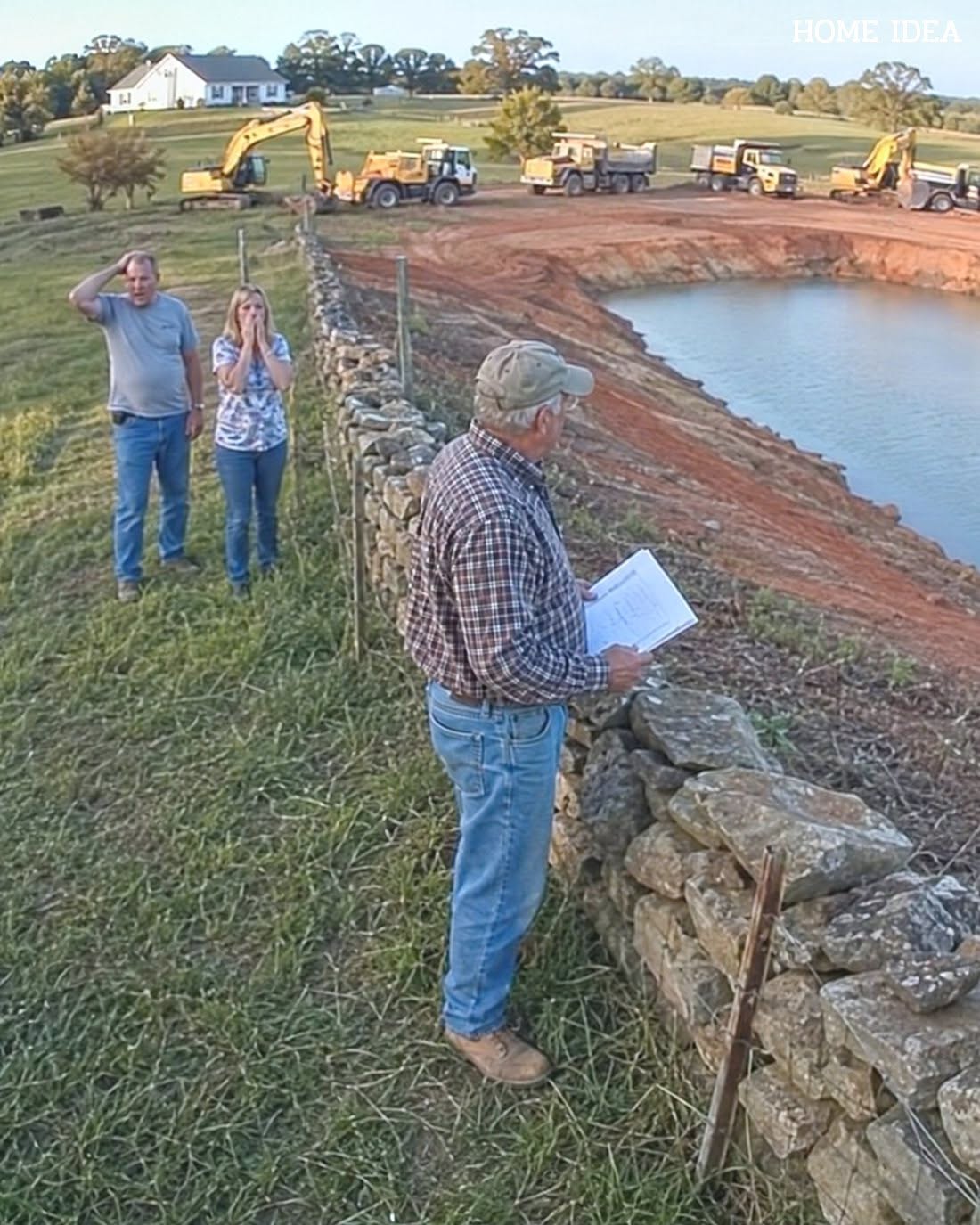
That is how encroachment works sometimes. Not with ugliness, but with beauty used as an argument. Once a wrong thing becomes attractive, people start asking whether undoing it is wasteful. They stop asking who had the right to do it in the first place.
I heard my grandfather again.
You let one thing slide, you teach people how to treat you.
On day twenty-two, I called Curtis Hale.
Curtis owned Hale Earthworks and had been moving dirt across three counties for more than thirty years. He was a compact man with a gray beard, heavy hands, and a voice that rarely rose above a gravelly murmur. He had buried water lines, built farm ponds, repaired washed-out roads, cleared storm damage, and once moved an entire hillside back where it belonged after a developer learned drainage the hard way.
He came out, looked at the lake, read the court order, and spat into the dirt.
“You sure?” he asked.
“Yes.”
“This won’t be pretty.”
“It wasn’t pretty when they dug it.”
He nodded. “We’ll do it clean.”
We met at sunrise two days later. Curtis brought two bulldozers, an excavator, three dump trucks, and men who worked quietly because good operators do not need to narrate power. Harold came too with his clipboard and camera. Ruth Ann told me to document everything, so we did. Photographs before. Photographs during. Copies of the order in three trucks and one in my back pocket.
Caleb stood beside me at the ridge, arms crossed. “You okay?”
“No.”
“You want to be talked out of it?”
“No.”
“Good. Because I wasn’t planning to.”
The air was cool for August, though it would not stay that way. Mist lifted from the unauthorized water. Birds moved along the bank, confused by the human drama gathering around their temporary habitat. Curtis walked up beside me.
“Last chance,” he said.
I looked at the lake and tried to imagine leaving it. Tried to imagine telling myself it was easier to settle, easier to sell that strip, easier to live with the thing and call it compromise. Then I imagined walking my future grandchildren to the stone fence and explaining why the boundary moved because one man had enough money to dig first and argue later.
“Do it,” I said.
The first bulldozer blade cut into the bank with a wet, tearing sound.
The lake fought harder than I expected. Water always looks calm until you ask it to leave. Mud slumped. Clay collapsed. The basin released itself in surges, not gracefully but angrily, rushing into the channels Curtis had cut to control the flow and return water toward the spring’s natural course. The dock tilted within the first hour, one side dropping as the supporting bank gave way. Men moved with chainsaws and straps, dismantling it section by section. Fountain pipes came out. Electrical lines were capped and removed. Ornamental grasses were pulled. Straw matting rolled back in filthy sheets.
By midmorning, Brent arrived in a cloud of gravel dust.
He jumped out before his truck stopped fully. “You can’t just do this!”
Harold held up the order.
“We gave you twenty-one days,” I said.
Laurel arrived minutes later, pale and furious, one hand pressed to her mouth as if she had discovered vandalism instead of enforcement. She stared at the dock sections stacked on a trailer.
“This is vindictive,” she said.
“No,” I replied. “This is restoration.”
“You’re destroying something beautiful.”
“You built it in the wrong place.”
Brent’s face flushed. “We were going to appeal.”
Ruth Ann had prepared me for that. “You didn’t file one.”
“We intended to.”
“Intentions don’t stay a court order.”
He looked toward Curtis’s machines, then back at me. “This could have benefited both of us.”
“You never asked me.”
That sentence stopped him longer than I expected.
Because that was the whole matter in its simplest form. Before lawyers, before surveys, before court orders, before bulldozers, before money, before pride—he had never asked. He had treated my land as an obstacle to his vision, not a neighbor’s inheritance.
Curtis and his crew worked for three days.
By the end of the first, most of the water was gone. By the end of the second, the basin had been filled in layers with soil hauled and pushed back into place. By the end of the third, the slope had been roughly restored to match its natural contour. It looked raw, wounded, and ugly, but honest. The spring ran again in its old channel, thin at first, cloudy with silt, then clearer as the disturbed mud settled.
When the last machine shut down, the silence felt heavier than the engine noise had.
Brent stood beside his truck, staring at the flattened earth.
“You’ll regret this,” he said.
Maybe he meant the legal fight. Maybe he meant neighborly relations. Maybe he simply needed to say something that sounded like power because all the visible evidence of his power was now loaded onto trailers or buried under clay.
I looked at the stone fence along the ridge.
“No,” I said. “I don’t think I will.”
For a week, there was quiet.
Too quiet.
Recent Articles
This young policewoman was filmed after her shift…see more
I Returned Home After 10 Years With the Son They Tried to Erase….See more

The 7 kilo baby who amazed the world in 1983: this is how it looks today, at the age of 40…..See more